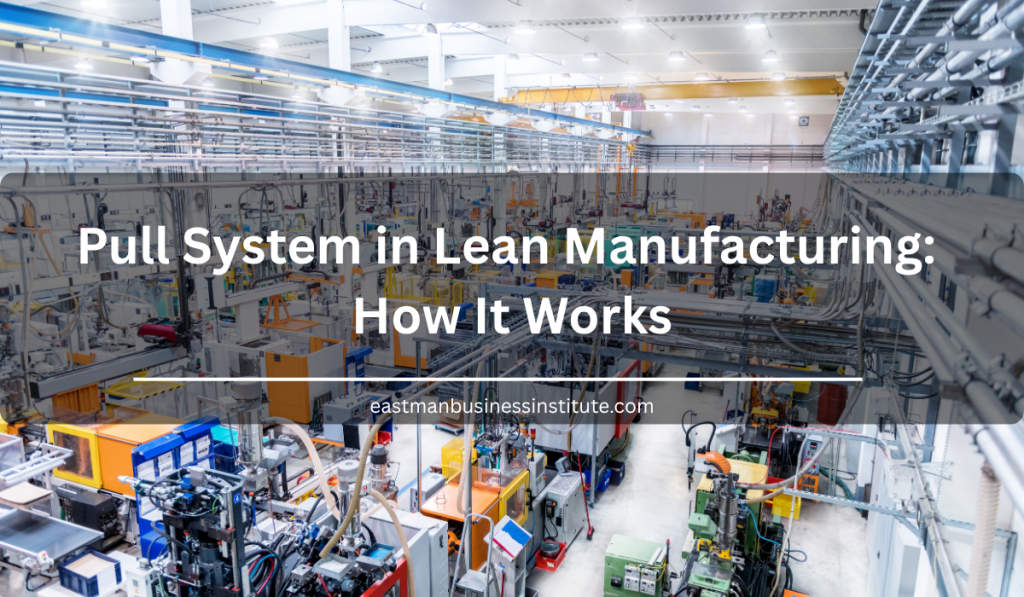

A pull system aligns production with actual customer demand to minimize waste and reduce inventory costs, contrasting with a push system that relies on forecasts and can lead to overproduction.
A pull system produces or replenishes only what downstream demand actually signals, instead of pushing forecasted volume through the process. Pull systems reduce inventory, cut waste, and expose bottlenecks fast — but they only work when demand signals are reliable and cycle times are short enough to respond.
What Is a Pull System?
A pull system controls production by allowing the downstream customer process to signal what it needs from the upstream supplier process. Lean Enterprise Institute defines pull production as a method in which downstream activities signal their needs upstream. The upstream process does not produce simply because capacity is available; it responds to an authorized need.
This principle is closely tied to Just-in-Time (JIT) production and the Toyota Production System (TPS). Toyota describes production-parts logistics as a pull system in which each process takes from the preceding process only what is needed, when it is needed, and in the amount needed. The purpose is to eliminate excess production and the inventory, handling, space, and hidden problems that often follow it.
Pull does not mean ‘make nothing until the final customer places an order.’ Some pull systems replenish a controlled supermarket of standard inventory as items are consumed. Others use sequential make-to-order logic. The defining feature is that an actual downstream signal authorizes upstream production or movement.
A simple pull loop looks like this:
| Step | What happens |
| 1. Consumption | A downstream process uses or withdraws a defined quantity of material. |
| 2. Signal | That withdrawal creates a Kanban or other replenishment signal. |
| 3. Authorization | The signal authorizes the upstream process to produce or move a defined quantity. |
| 4. Replenishment | The upstream process replaces what was consumed rather than producing an arbitrary extra amount. |
| 5. Repeat | The loop repeats as downstream consumption creates new signals. |
The signal can be a physical card, empty container, marked space, electronic message, barcode event, e-Kanban, or another mechanism. What matters is the rule: no unauthorized production or movement.
Pull is therefore both a material-flow and information-flow concept. Material moves downstream toward the customer, while demand information moves upstream to authorize replenishment.
Pull vs Push Production
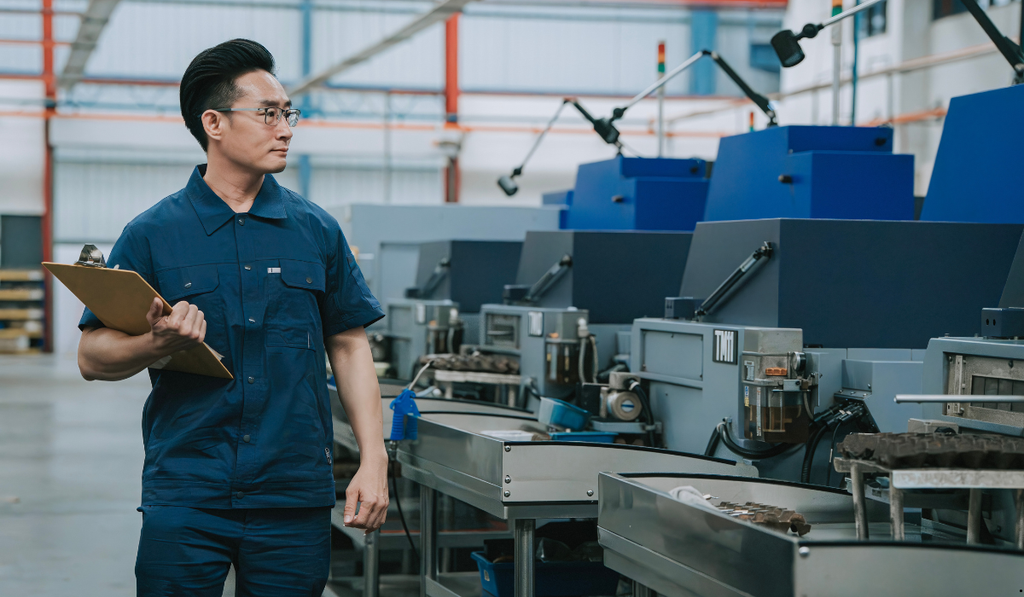
Push and pull differ mainly in what authorizes production. A push system typically releases work according to a plan, forecast, schedule, or expected demand. A pull system releases or replenishes work because a downstream process has consumed or requested something.
| Dimension | Pull production | Push production |
| Trigger | Actual downstream consumption or authorized need | Forecast, master schedule, planned release, or expected demand |
| Information flow | Demand signal moves upstream | Schedule typically drives work forward from upstream |
| Production logic | Replenish or make what has been consumed/requested | Produce according to planned quantities and timing |
| Inventory tendency | Designed to limit and control WIP/inventory | Can create excess inventory if forecasts and actual demand diverge |
| Overproduction risk | Lower when pull rules and limits are maintained | Higher when production continues despite weak downstream consumption |
| Visibility of problems | Shortages, delays, and instability become visible quickly | Inventory buffers can hide problems longer |
| Best conditions | Stable enough processes, reliable replenishment, controlled WIP, reasonably understood demand | May be useful where long lead times, economies of scale, or constraints require advance production planning |
| Typical Lean mechanism | Kanban, supermarket, FIFO lane, sequential pull | Central schedule or forecast-driven work release |
Push is not automatically bad, and pull is not automatically appropriate everywhere. Every real supply chain uses some forecasting and planning. Even a mature pull system needs capacity planning, supplier coordination, demand information, and rules for exceptional conditions.
The Lean distinction is more specific: do individual upstream processes produce because a downstream customer has authorized the need, or do they produce independently according to schedules and push the result forward?
This matters because local efficiency can conflict with system performance. A machine may appear highly productive when it runs continuously, but if downstream demand cannot absorb the output, the ‘productivity’ becomes excess inventory. Pull discourages this form of overproduction.
Toyota’s Just-in-Time history captures the central idea: produce what is needed in time, but do not make too much. That logic eventually developed into the supermarket and Kanban systems used to connect processes.
How a Kanban Pull System Works
Kanban is a signaling mechanism used to authorize production or withdrawal in a pull system. The Japanese word kanban means sign or signboard. A Kanban can be a card, but Lean Enterprise Institute notes that signals can also be plates, colored objects, electronic signals, or other devices that communicate the correct instruction.
A common supermarket pull system uses two related signals: withdrawal Kanban and production Kanban.
Withdrawal Kanban
A withdrawal Kanban authorizes material to be moved from an upstream supermarket to the downstream consuming process. It tells the material handler what item to retrieve, how much to move, and where it is needed.
Production Kanban
A production Kanban authorizes the upstream process to replace the material removed from its supermarket. If one container is withdrawn, the corresponding production signal typically authorizes production of one replacement container, subject to the system’s defined rules.
The replenishment loop
Imagine an assembly cell that consumes bins of 20 brackets. When a bin is needed, the material handler brings a full bin from the supermarket to assembly. Removing that full bin exposes or releases the signal associated with it. That signal goes to the bracket-producing process and authorizes one replacement bin of 20.
The supplier process does not make 200 extra brackets merely because it has spare time. It replaces the authorized quantity. As long as production and movement do not occur without the appropriate signal, the loop maintains pull.
| Kanban element | Purpose |
| Part / item identification | Prevents the wrong material from being replenished. |
| Container quantity | Defines the standard amount associated with the signal. |
| Supplying process / location | Identifies where replenishment originates. |
| Consuming process / location | Identifies where the material is needed. |
| Production signal | Authorizes making the replacement quantity. |
| Withdrawal signal | Authorizes moving the defined quantity downstream. |
| Number of Kanban signals | Helps place an explicit limit on inventory/WIP in the loop. |
The number of Kanban cards or containers should be intentionally sized. Too many signals create excess inventory and can hide problems. Too few can cause repeated shortages when lead time, variation, reliability, or demand has not been stabilized.
A common starting relationship for a container-based Kanban loop is:
Number of Kanban = [Demand rate x Replenishment lead time x (1 + Safety factor)] / Container quantity
The result is normally rounded up to a whole signal/container. The formula is a planning model, not a substitute for observing the real process. Demand, lead time, container size, downtime, changeovers, supplier reliability, scrap, and variability must be understood before the loop is finalized.
For a deeper explanation of card sizing and replenishment logic, see Kanban System for Inventory Management.
Pull System in Inventory Management
Pull changes inventory from an uncontrolled consequence of scheduling into an intentionally managed part of the replenishment system. A supermarket is a common example. Lean Enterprise Institute defines a supermarket as a location where a predetermined standard inventory is maintained to supply downstream processes.
Each item has a defined location and quantity. When downstream consumption removes an item or container, a signal goes upstream to replace it. The supermarket therefore decouples processes that cannot operate in continuous flow while still connecting production to actual use.
Why a supermarket exists
Continuous one-piece flow is preferred where processes can be directly linked, but it is not always possible. Equipment may have long changeovers, processes may be physically separated, suppliers may be remote, or one process may serve many product families. In those cases, a controlled supermarket can provide a buffer without abandoning pull.
Lean Enterprise Institute’s value-stream guidance specifically recommends supermarkets to control production where continuous flow cannot extend upstream.
Pull does not mean zero inventory
This is one of the most important misconceptions. Pull seeks the appropriate amount of inventory needed to support reliable flow, not inventory elimination at any cost. A pull loop may deliberately contain raw material, WIP, or finished goods in standard quantities.
The difference is that the quantity is visible, limited, and replenished by consumption. Inventory should have a defined purpose rather than accumulating because upstream processes continue producing.
Other pull-system designs
Supermarket pull is the most widespread form, but it is not the only one. Lean Enterprise Institute distinguishes three broad designs:
| Pull-system type | How it works | When it may fit |
| Supermarket pull | Each process replenishes a controlled stock of products as downstream customers withdraw them. | Relatively repeatable demand and a manageable number of part numbers. |
| Sequential pull | Products are made in a defined sequence, often closer to make-to-order, without keeping every item in a supermarket. | Too many part numbers to economically stock every variant; short and predictable lead times are important. |
| Mixed pull | Uses supermarket pull for some products and sequential pull for others. | Product mix contains high-volume repeaters plus lower-volume or infrequent items. |
The right design depends on product variety, volume, replenishment lead time, demand patterns, process reliability, changeover capability, and the cost or practicality of holding each item.
Benefits of Pull Systems
Less overproduction
Overproduction is especially damaging because it creates other wastes: inventory must be stored, counted, handled, transported, protected, and eventually consumed or written off. By tying production authorization to downstream need, pull directly attacks this problem.
Lower and more visible inventory
Kanban quantities, container sizes, supermarket limits, and FIFO lanes make the intended inventory level visible. When the system is working, extra inventory cannot accumulate unnoticed without violating a defined rule.
Faster exposure of process problems
Large buffers can hide unreliable machines, long changeovers, quality problems, poor schedules, and unstable suppliers. A carefully sized pull system reduces the cushion and makes abnormalities visible sooner. The goal is not to create shortages deliberately; it is to expose the causes that prevent reliable flow.
Better connection between demand and production
Consumption becomes the replenishment trigger. This helps upstream processes respond to what downstream customers actually use rather than producing solely from assumptions about what they might need.
Reduced work in process
Limiting the number of authorized signals limits the amount of material that should circulate within the loop. Lower WIP can reduce floor-space requirements, handling, queue time, and the time defects remain hidden before reaching the next process.
Clearer priorities
A well-designed Kanban system answers a practical question for the supplying process: what am I authorized to produce next? This can reduce conflicting instructions and unscheduled expediting.
Support for continuous improvement
Pull makes abnormalities visible. If a supermarket repeatedly empties, the team can investigate demand spikes, downtime, replenishment time, changeovers, quality losses, or incorrect sizing. If inventory never falls, the loop may be oversized. The pull system becomes a management mechanism for learning, not just a way to move bins.
When Pull Systems Break Down (Limitations)
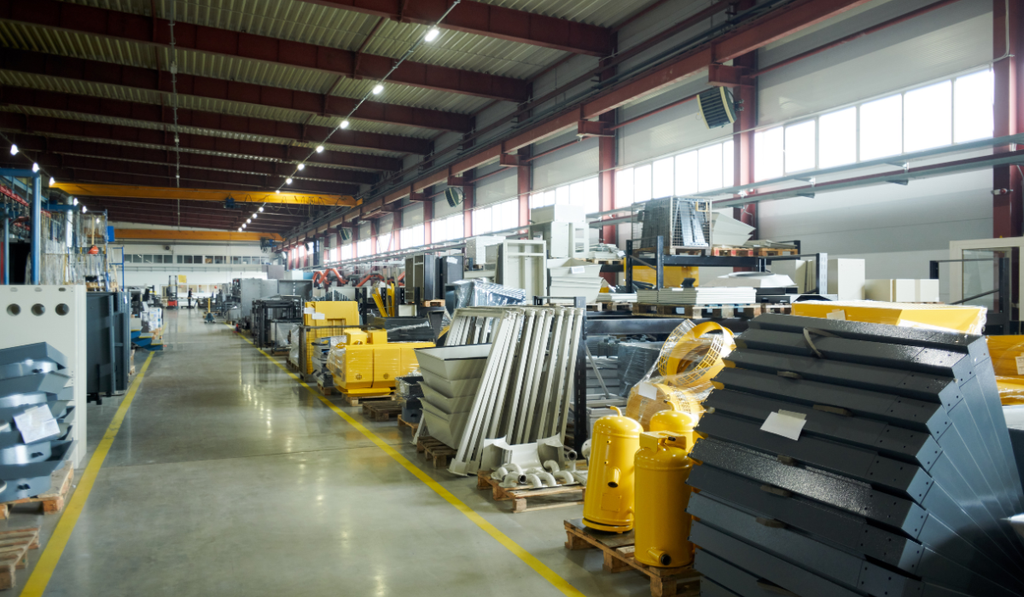
Pull is powerful, but it depends on operating conditions that support reliable replenishment. Installing Kanban cards on an unstable process does not make the process Lean.
Highly unstable demand
If consumption changes dramatically without warning, a fixed supermarket or Kanban quantity may be repeatedly too large or too small. Teams may need segmentation, revised safety factors, faster replenishment, capacity flexibility, or a different pull design.
Long or unpredictable replenishment lead times
A signal cannot protect the customer if the upstream process or supplier takes too long to respond. Longer lead time requires more inventory to cover demand during replenishment. Reducing and stabilizing lead time is often more valuable than simply adding Kanban.
Unreliable equipment
Frequent downtime prevents the supplying process from replenishing what downstream operations consume. A pull system can expose this weakness quickly, but maintenance and reliability problems must actually be solved.
Poor quality
If containers contain defects, the apparent inventory is greater than the usable inventory. Defects can therefore create shortages even when the Kanban count looks correct. Quality at the source is essential.
Long changeovers and inflexible batch sizes
A process that can only economically make large batches may struggle to replenish small quantities frequently. Setup reduction, smaller transfer quantities, and product-family analysis may be needed before tighter pull is practical.
Too many product variants
A supermarket containing every possible low-volume variant can become expensive and complex. Sequential or mixed pull may be more appropriate when product variety is high.
Ignoring the Kanban rules
The system fails when employees produce without a signal, create unofficial extra cards, hide emergency inventory, move material without authorization, or continue using obsolete quantities after demand changes. These workarounds destroy the WIP limit and disconnect production from consumption.
Confusing pull with the absence of planning
Pull does not eliminate forecasting, capacity planning, supplier planning, sales and operations planning, or long-term investment decisions. It changes how work is released and replenished within the operating system. Organizations still need to anticipate capacity, labor, material, and supplier requirements.
| Failure symptom | Likely issue to investigate |
| Frequent stockouts | Lead time, downtime, demand variability, quality loss, Kanban sizing, or replenishment discipline |
| Inventory continually grows | Unauthorized production, too many Kanban, oversized containers, weak withdrawal discipline |
| Constant expediting | Replenishment time is not capable of meeting the pull loop’s assumptions |
| Operators ignore signals | Rules are impractical, training is weak, or management overrides the system |
| Many emergency buffers | Underlying reliability, quality, scheduling, or supplier problems are unresolved |
| High-volume items work but rare variants fail | Product segmentation or mixed/sequential pull may be needed |
A good pull system therefore requires stable enough processes, explicit rules, reliable quality, appropriate inventory sizing, responsive replenishment, disciplined management, and continuous adjustment as conditions change.
Pull System Example (Walkthrough)
Consider a small assembly line that uses a stamped bracket. Assembly consumes an average of 200 brackets per day. The stamping process replenishes the supermarket once per day, brackets move in containers of 50, and the team chooses an illustrative 20% safety factor while the process is being stabilized.
Step 1: Define demand
Average downstream demand = 200 brackets per day.
Step 2: Define replenishment lead time
Replenishment lead time = 1 day.
Step 3: Add the illustrative safety factor
Demand during lead time with the example allowance = 200 x 1 x 1.20 = 240 brackets.
Step 4: Divide by container quantity
240 / 50 = 4.8 containers. Because the system cannot circulate 0.8 of a standard Kanban container, round up to 5.
Step 5: Establish the loop
The system therefore begins with five authorized 50-bracket containers, representing a maximum modeled quantity of 250 brackets associated with the loop. This is an illustrative starting design, not a universal rule.
Step 6: Downstream consumption creates the signal
Assembly withdraws one 50-bracket container from the supermarket. The withdrawal authorizes movement to assembly, and the associated production signal returns to stamping.
Step 7: Upstream replenishes only what was withdrawn
Stamping receives authorization to produce one replacement container of 50. It does not automatically produce five more containers. When the replacement is complete, it returns to the supermarket and restores the standard quantity.
Step 8: Problems become visible
Suppose the supermarket repeatedly empties before stamping replenishes it. The team should not immediately add more cards. First it investigates why: Did demand rise? Did the press stop? Was the changeover late? Were parts scrapped? Did the material handler miss a route? Is the one-day replenishment assumption wrong?
Step 9: Improve the process, then resize if necessary
If the team reduces replenishment lead time from one day to half a day while demand and other assumptions remain unchanged, the same illustrative formula becomes:
200 x 0.5 x 1.20 / 50 = 2.4, rounded up to 3 containers.
That example shows an important Lean relationship: reducing replenishment lead time can allow the pull loop to operate with less inventory. The goal is not to arbitrarily remove two containers and hope the process survives. The goal is to improve the system so fewer containers are genuinely required.
| Metric | Initial state | Improved illustrative state |
| Daily demand | 200 brackets | 200 brackets |
| Replenishment lead time | 1.0 day | 0.5 day |
| Safety factor used in example | 20% | 20% |
| Container quantity | 50 | 50 |
| Calculated Kanban | 4.8 -> 5 | 2.4 -> 3 |
| Authorized container capacity | 250 brackets | 150 brackets |
In practice, the team would validate the assumptions with actual demand distribution, downtime, replenishment performance, quality loss, changeover behavior, supplier constraints, and service expectations. The example demonstrates the logic, not a universal safety-factor recommendation.
Conclusion
A Lean pull system changes the question from ‘What can we produce?’ to ‘What does the downstream customer actually need us to replenish?’ That shift helps control overproduction, inventory, WIP, and conflicting priorities while making process problems easier to see. Kanban provides one of the clearest ways to transmit the signal, and supermarkets provide controlled inventory where continuous flow is not practical. But pull is not a shortcut around unstable equipment, poor quality, long changeovers, unreliable suppliers, or unpredictable replenishment. Those weaknesses become more visible when excess inventory no longer hides them. The strongest pull systems therefore combine clear authorization rules with reliable processes, intentional inventory sizing, disciplined management, and continuous improvement. When those conditions are present, actual consumption can guide production with far less waste than independent upstream scheduling.
Frequently Asked Questions
What is the difference between Lean, Six Sigma, and Agile?
Lean targets waste and flow, Six Sigma targets variation and defects, and Agile targets speed of change under uncertainty. Lean and Six Sigma are usually combined (Lean Six Sigma) for operational improvement. Agile is more common in software and product development.
Can you use Lean, Six Sigma, and Agile together?
Yes. Many organizations combine Lean with Agile (Lean-Agile) for software delivery, and Lean Six Sigma is a standard operational improvement framework. The methodologies overlap on principles like customer value and continuous improvement, so combinations are natural.
What are the core Lean principles?
The five core Lean principles are: define value from the customer’s perspective, map the value stream, create flow, establish pull, and pursue perfection. These come from Womack and Jones’s book Lean Thinking and are the foundation of Toyota Production System-based improvement.
Which Lean or Six Sigma certification should I get first?
Start with a Lean Six Sigma Yellow Belt if you’re supporting improvement work or a Green Belt if you’re leading projects. Pure Lean certifications, such as Shingo or LEI certifications, are valuable for manufacturing-focused careers. Agile certifications, such as Scrum Master, suit software and product careers.
Should I get Lean certification or Six Sigma certification?
Choose based on the work you want to perform. Lean certification is especially relevant to waste reduction, flow, value streams, and Lean transformation. Six Sigma belts are especially relevant to DMAIC, variation, quality, and analytical problem solving. For roles spanning both, a credible Lean Six Sigma program may be appropriate.